


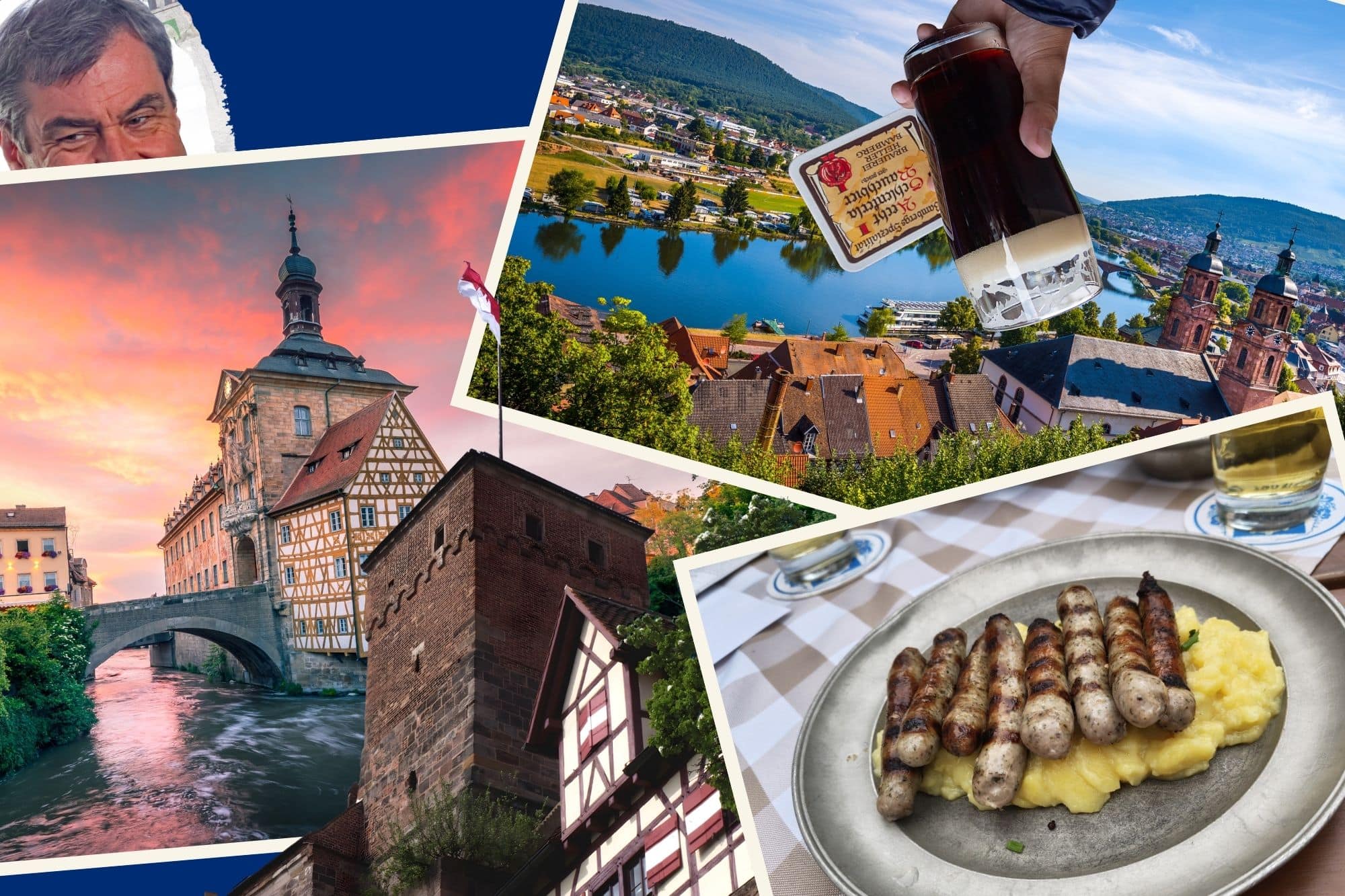
Almost every year, our editor Konrad is drawn to the land of Franconia in Bavaria, Germany. He has gradually learned what exactly Upper and Lower Franconia are, why there is so much sausage there, and where the border between Wine and Beer Franconia runs. So here, at last, is our comprehensive guide with everything you need to know about Franconia.
Where is Franconia in Germany?
The Franconia region is located in the northern part of the Free State of Bavaria and is therefore – much to the chagrin of some residents – not a separate federal state. When people in Germany talk about Franconia, they usually mean this part of Bavaria. However, the Franconian dialect also “spills over” into the neighboring federal states of Baden-Württemberg, Hesse, Thuringia, and Saxony in some places. Many Franconians consider Nuremberg to be the unofficial capital, as it is the second largest city in Bavaria after Munich.
Franconia Is Not Bavaria
Although Franconia is (largely) located in the Free State of Bavaria, the Franconian identity is quite strong, and anyone who lumps Franconia and Bavaria together in conversation with a Franconian is likely to notice this quite quickly. Until the early 19th century, Franconia and Bavaria were two independent political entities. It was Napoleon who first incorporated the various Franconian territories into the newly formed Kingdom of Bavaria. But even though the Franconians insist on their own identity, most of them are quite happy as residents of the state of Bavaria. The best example of this is the Bavarian Minister President Markus Söder, who was born in Nuremberg.
Where Are Upper Franconia, Middle Franconia, And Lower Franconia?
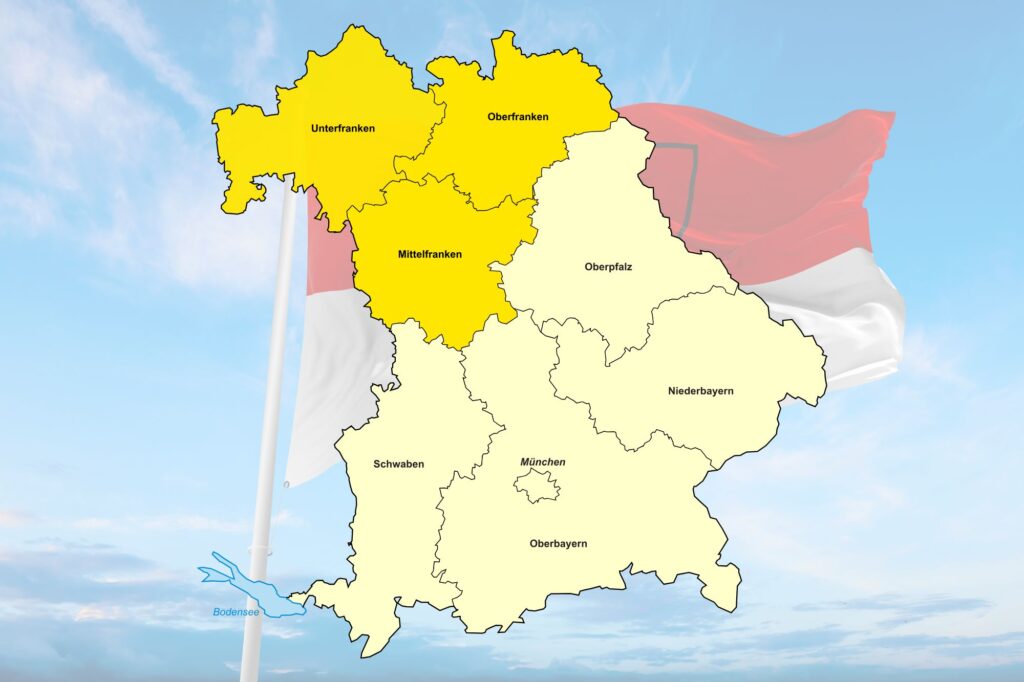
Franconia is quite large and covers about one-third of Bavaria’s total area. Accordingly, Franconia is not just Franconia. The simplest division of Franconia is its three administrative districts: Upper Franconia, Middle Franconia, and Lower Franconia. However, these are not located strictly above or next to each other, but slightly offset: Upper Franconia in the northeast, Lower Franconia in the northwest of Bavaria, and Middle Franconia exactly in the middle below.
Upper and Lower Franconia get their names from the Main River. The river originates near Kulmbach and then flows westward until it empties into the Rhine. The upper course of the river, which is closer to its source, therefore flows through Upper Franconia. And the lower course of the Main flows through Lower Franconia to the westernmost city in Franconia: Aschaffenburg. Beyond that lies Hesse. Middle Franconia, on the other hand, is not crossed by the Main, but is located in the middle. It’s that simple.
Which Cities Are Located in Franconia?
Around 4.5 million people live in the Franconia region. And not all of them live in the countryside. On the contrary: Franconia is full of beautiful medium-sized and large cities, all of which are worth a visit. Here are our favorites.
Nuremberg
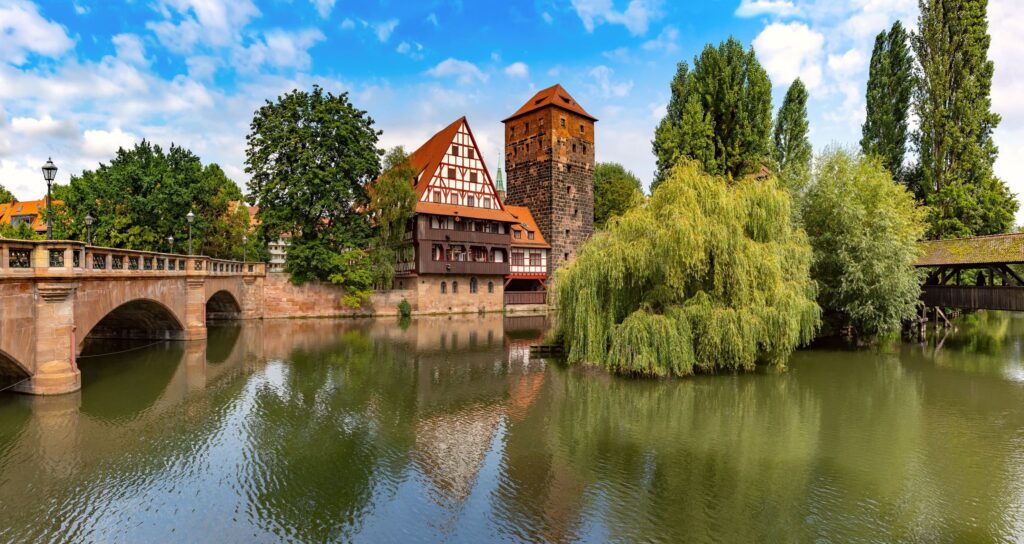
With more than 500,000 inhabitants, Nuremberg is not only one of the largest cities in Bavaria, but also one of the 15 largest cities in Germany. So it’s no wonder that the unofficial capital of Franconia is buzzing with life and excitement. One of the highlights of a visit is a climb up to the unmissable Imperial Castle, from whose walls you can enjoy an incomparable view of the red roofs of the old town. And of course, gingerbread is a must-have souvenir, available here all year round, not just during the Christmas market.

Bamberg
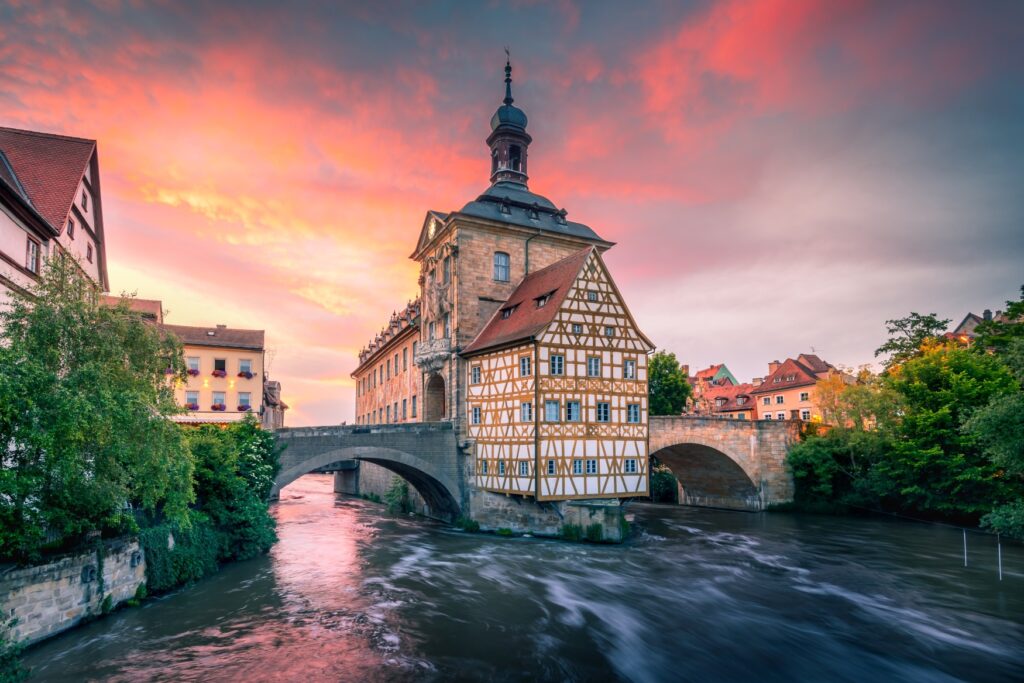
The baroque jewel of Bamberg not only boasts one of the highest densities of breweries in Germany, but also two rivers with riverside promenades. Actually, it is the same river, the Regnitz, which divides into a left and a right branch in Bamberg. And on the island between them lies a large part of the historic old town, which is part of the Unesco World Heritage Site. If that’s not reason enough to take a trip there, what is?
Würzburg
Würzburg is the second largest city in Franconia after Nuremberg. However, the difference in population is clearly noticeable: in 2024, 133,000 people lived here. A significant number of them study at the local university, with almost 30,000 people enrolled there. And this is reflected in the city’s cultural life. Several stages and choirs shape the city’s cultural life, and the nightlife is also impressive. Speaking of impressive: two absolute eye-catchers are the Marienberg Fortress – together with the Main Bridge, a must-see photo opportunity – and the imposing Episcopal Residence in the middle of the old town.

Bayreuth
Many people probably know Bayreuth primarily as the venue for the annual Wagner Festival. And yes, this is probably the biggest event in the Upper Franconian city’s annual calendar. But even away from Valkyries and Nibelungen rings, Bayreuth has nothing to hide. Several castles and fairytale gardens invite you to take a dreamy stroll, and the local Bayreuther brewery has set up an entire beer experience world in the middle of the city. Cheers!
Coburg
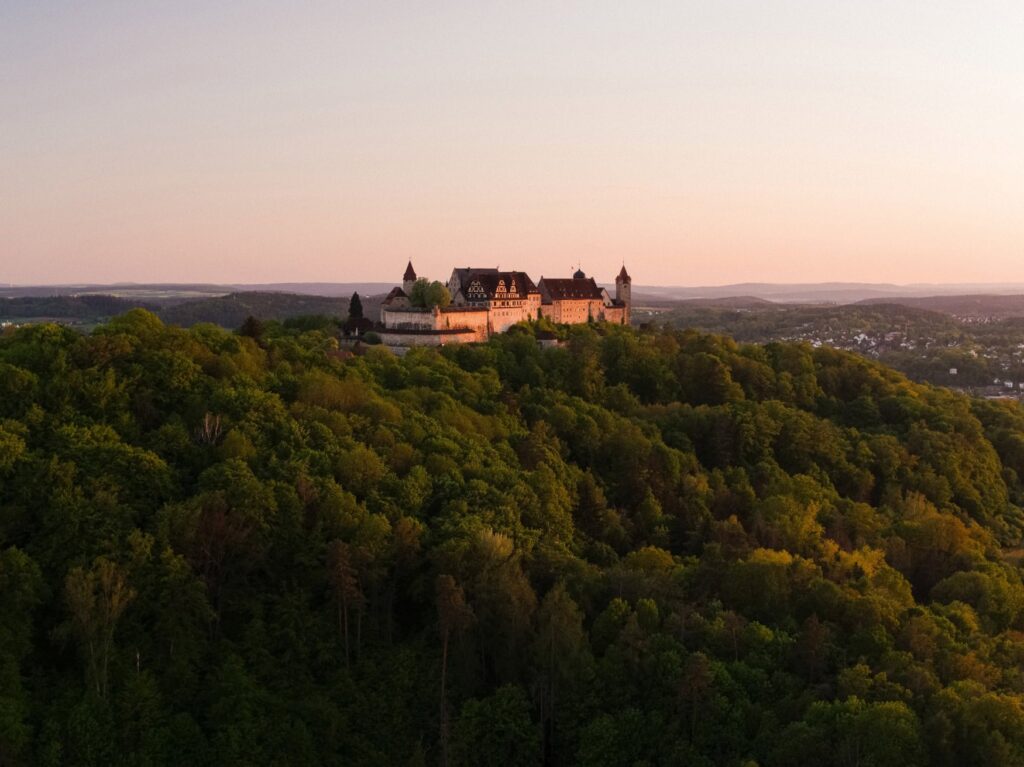
Almost in Thuringia, Coburg is the northernmost tip of the region. The small town is a real medieval gem, with many colorful half-timbered facades and seemingly endless sunshine. A visit to Ehrenburg Castle is a must, and those who are not afraid of the climb can make their way up to the imposing Veste Coburg. The fortress, which has never been taken in battle, towers over the city and offers a view of the surrounding region for miles around. Oh, and once a year, the city is transformed into a hot, dancing, drumming cauldron during the Samba Festival.

Aschaffenburg
Aschaffenburg is just a stone’s throw from Frankfurt, right on the border with Hesse. As a result, the cultures here sometimes blur, and instead of white wine, people in “Aschebersch” like to drink “Eppler” (a Hessian form of Cider) from a “Bembel” (the traditional Hessian stone jug). Ajoo. Visually, the old town is wonderfully Franconian and medieval, with lots of half-timbered houses and the imposing Johannisburg Castle, the town’s landmark.
Rothenburg ob der Tauber
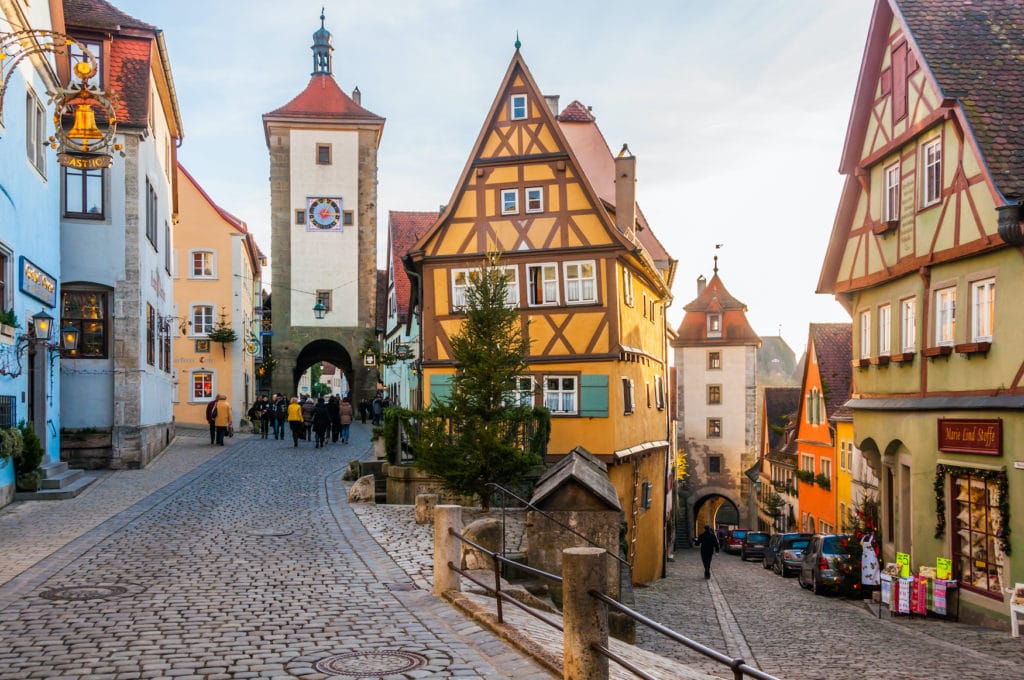
Franconia remains medieval, and how! When visiting Rothenburg ob der Tauber, you might think you’ve stepped through a portal straight into the past. The city is incredibly well preserved, with narrow alleys, pretty facades, quaint taverns, and a breathtaking view of the idyllic Tauber Valley. Even the city wall is more or less completely preserved. If you want to get ready for Christmas at any time of the year, Käthe Wohlfahrt is the place to go. And no visit to the medieval town is complete without sampling a “Schneeball” (snow ball) at one of the many bakeries.
Franconian Specialties, Beer, and Wine
Franconia is, without a doubt, a region of culinary delights. That may sound like advertising, but it’s true. No other region in Germany has such a high density of independent butchers, bakeries, winemakers, and breweries. Accordingly, there are many specialties that the Franconians are rightly proud of.
Beer And Wine Franconia
Are we back to regional divisions again? Almost. The actual border through the region runs between Wine Franconia and Beer Franconia. Wine Franconia is the Franconian wine-growing region, one of 13 German wine-growing regions. It stretches along the entire lower reaches of the Main River to approximately Bamberg. Dry white wines such as Silvaner and Müller-Thurgau are typical of the region, but red wine is also produced, especially in Churfranken – between Aschaffenburg and Miltenberg. Particularly high-quality Franconian wines are sold in Bocksbeutel, a wide, bulbous bottle.
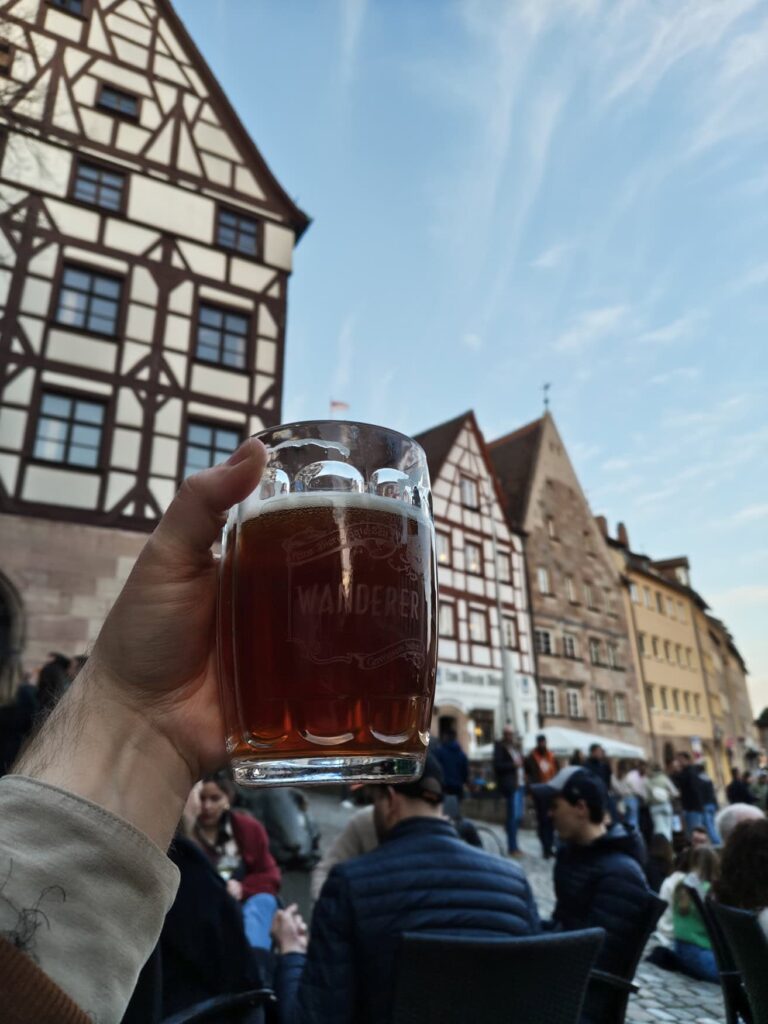
Beer Franconia, on the other hand, is mainly located in the east of the region. Bamberg, Bayreuth, Kulmbach, and Nuremberg are brimming with venerable breweries that serve not only the region’s typical light beer but also plenty of other specialties. Such as the malty red beer in Nuremberg. A visit to a beer garden or beer cellar is simply a must here in summer.

Sausage, Sausage, Sausage
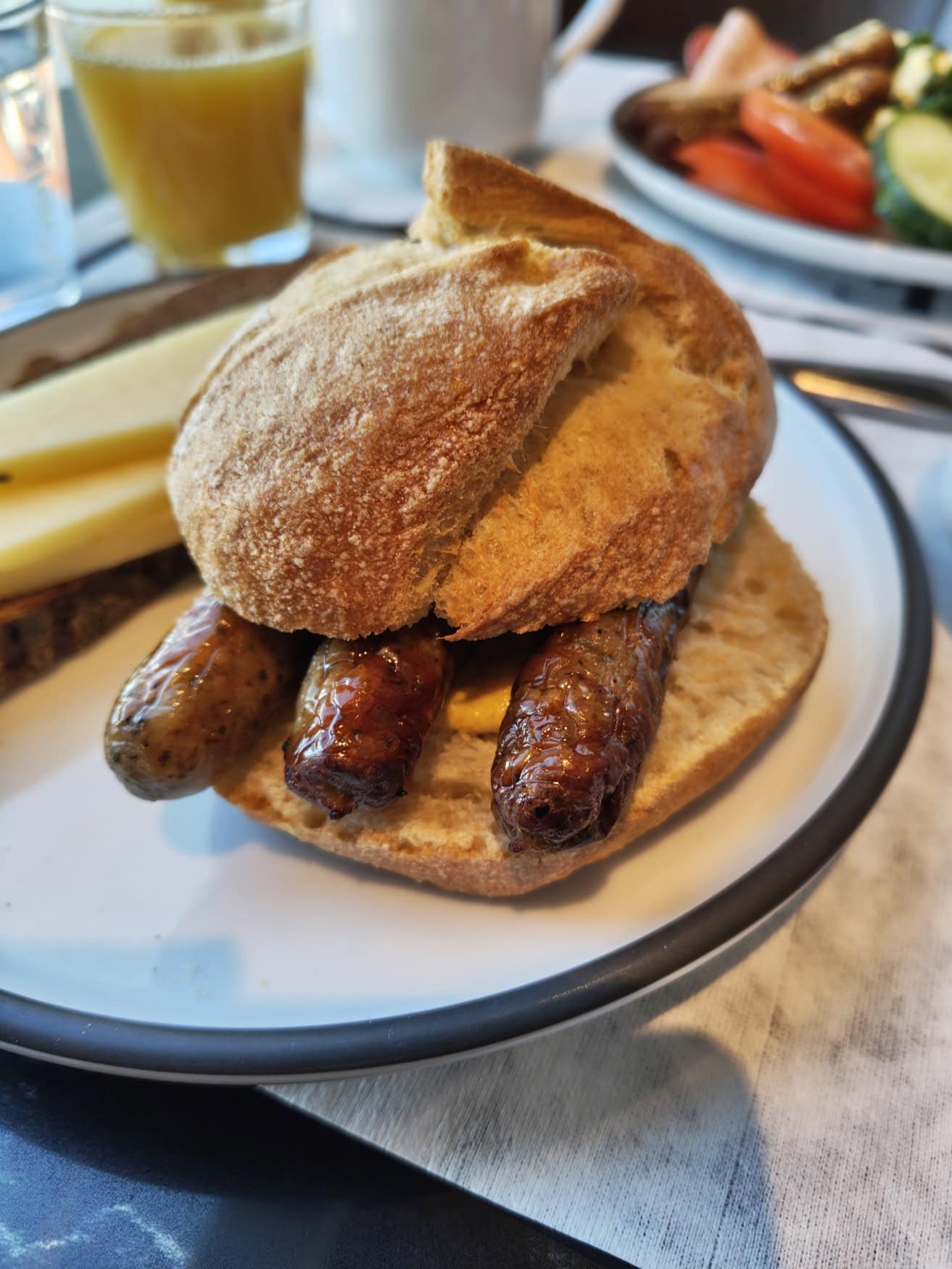
It should come as no surprise that good sausage is an essential part of Franconian cuisine. Nearly every village, no matter how small, has its own sausage specialty, whether it’s the small Nuremberg grilled sausages, the Coburg bratwurst with a spicy filling, or the Treuchtlingen bratwurst. The main thing is that it’s round.

Dumpling With Sauce
No Franconian restaurant can do without potato dumplings with sauce on the menu. These not-so-small potato balls with brown sauce are either a meal in themselves or serve as a side dish to mostly hearty meat dishes. Perfect for soaking up large amounts of sauce and transporting it to your mouth. By the way: in 2025, the world’s largest potato dumpling was cooked in Wombach, Franconia. Fighting weight: 465 kilograms.

What Else Is There To Do In Franconia?
So, now we’ve taken a detailed look at Franconia’s beautiful cities and its lean regional cuisine. What else does the region have to offer? Quite clearly: plenty of nature that is well worth exploring. There’s no other way to put it: Franconia is simply a really beautiful region. It can be explored in many different ways, whether by car, train, hiking, or on a multi-day bike tour. Either way, a trip to the Main is well worth it. We are already planning our next trip.
Still have questions? The Franconians themselves know everything there is to know about Franconia. Click here to visit the tourism website for the Franconia region.